
Cleveland City Directory Holdings
The Cleveland Bradley County Library History Branch is the practical first stop for historical volumes. Its public collection summary does not publish a complete shelf list, so a researcher should ask staff for city, telephone, reverse, or criss-cross volumes by year. The verified leads are fragmented: official and state-library-related sources point to volumes from 1949, 1952, 1955, 1957, 1959, 1960, 1962, 1964, 1966, and 1990 through 1992. A 1993 through 1999 platform lead needs confirmation before it is treated as a local holding.
| Collection | Years | Where Held | Access |
|---|---|---|---|
| Cleveland directory volumes | Verified leads from 1949 to 1992; 1993-1999 to confirm | History Branch, state archive, or platform | Ask staff or the holding institution by volume |
| Cleveland newspapers | 1854-1970 | History Branch microfilm | In-person research and branch copy rules |
| Obituary index | 1865-present, updated daily | Cleveland Bradley County Library | Free name search; copies by request |
| Sanborn map leads | 1925, 1930, 1950 | NPS bibliography, Library of Congress, or local archive | Map collection availability varies |
| Bradley historical material | 1850 map; 1860-1861 and 1860-1865 leads | Genealogy index or archive holder | Confirm the specific item before citing it |
No official source located the first issue, the final issue, a publisher list, or a complete run. Record the volume year, page, and holding location before drawing a conclusion from a Cleveland volume. That simple habit makes a later return to the same shelf or reel much easier.
Note: A directory date may differ from the date a household moved, so compare print, census, deed, and obituary dates separately.
Cleveland History Branch
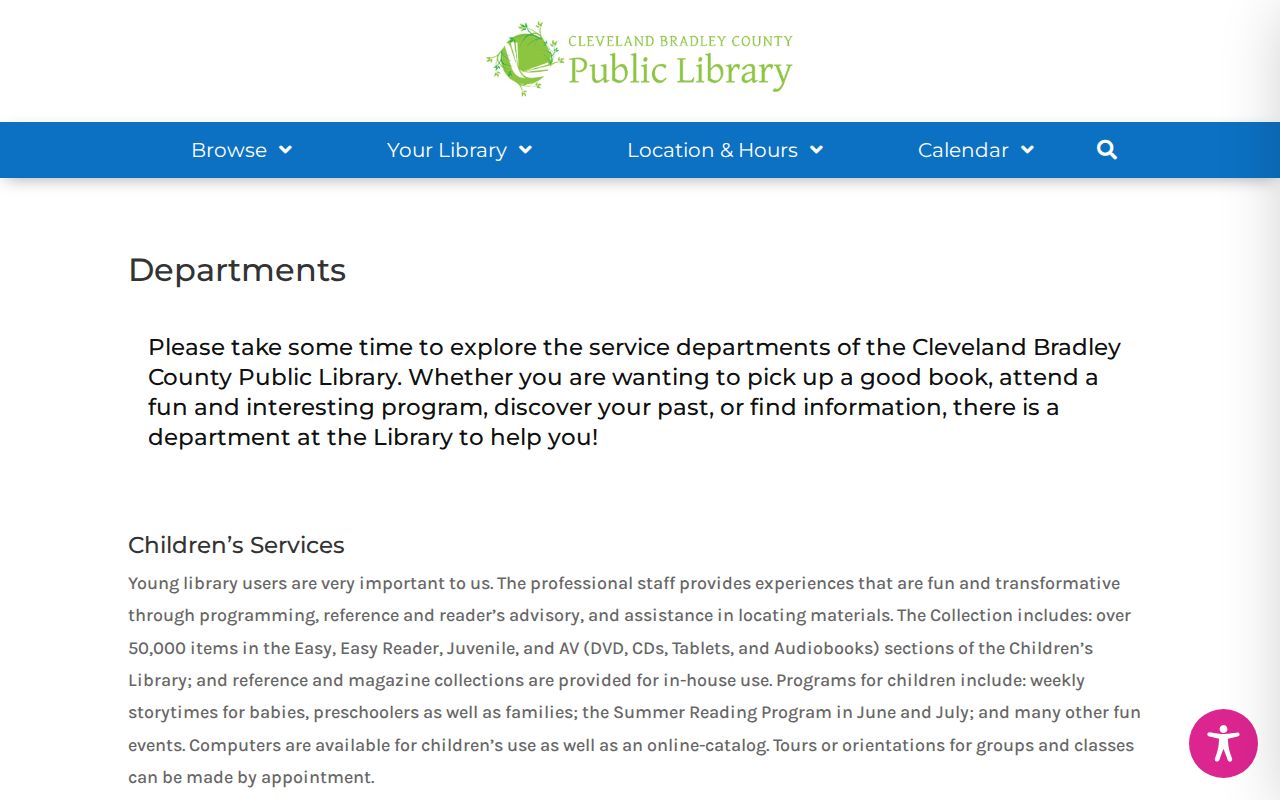
The History Branch and Archives is at 833 N Ocoee Street in the Craigmiles House. The house dates to 1866, served the library from 1922, and entered the National Register in 1975. Its holdings reach beyond directory volumes to family and city histories, vital and early court material, photographs, scrapbooks, manuscripts, Civil War material, and newspapers. Fragile material is staff handled, and the branch asks visitors to use pencils rather than pens.
See the History Branch department information before a visit.
Bring the known name, a date range, and every version of an address. Staff can then check whether a city directory, telephone book, yearbook, local map, funeral-home file, or family file is the better first source.
Requests also have several documented channels: visit the branch, call 423-479-8367, email hbranch@clevelandlibrary.org, or mail a request to 833 Ocoee St NE, Cleveland, TN 37311. The library contact page supplies the branch contact route and web form.
Ask whether a requested item must be retrieved, whether copying is permitted, and whether a licensed database requires in-library access. Those details vary by collection.
Reading Cleveland City Directory Entries
No accessible official source provided a page from a local volume. That means a Cleveland entry should be read from the actual book, not from assumptions borrowed from another city. On the first usable page, capture the volume year and page number, then note which fields are truly printed. The research identified useful fields to check, but it did not verify that every Cleveland volume contains each one.
| Name and relationship | Capture the head name and any spouse or household relationship only if printed. |
|---|---|
| Address | Copy the house number, street spelling, directional suffix, apartment or room information, if present. |
| Work or business line | Record an occupation, business, or employer only when the local entry actually shows it. |
| Notation | Preserve any ownership, widow, telephone, or cross-reference notation exactly as printed. |
| Abbreviations | Photograph or transcribe the volume's own key before interpreting a shortened mark. |
- Criss-cross directory
- A possible street-order section that may group entries by address. Its presence must be verified in each Cleveland volume.
- Householder index
- A name-oriented index that can point to a household entry, if the volume includes one.
- Abbreviation key
- The volume's explanation of shortened labels. Use that key rather than assigning a meaning from memory.
A name section, business section, and street section can disagree because they were compiled at different points in a publication cycle. Copy the wording as printed, including initials and Ocoee spelling, before comparing it with another record.
Cleveland City Directory Obituaries
The library's obituary index is a strong companion when a name disappears from a historical volume. It reaches back to 1865 and is updated daily. Search by first and last name, then use the returned middle name, nickname, age, publication date, publication, page number, notes, and internal ID as leads for a microfilm check. A notice may identify relatives, a cemetery, a funeral home, or a former address, but those details should be confirmed in the underlying record.
The obituary-results page shows the fields produced by the library search.
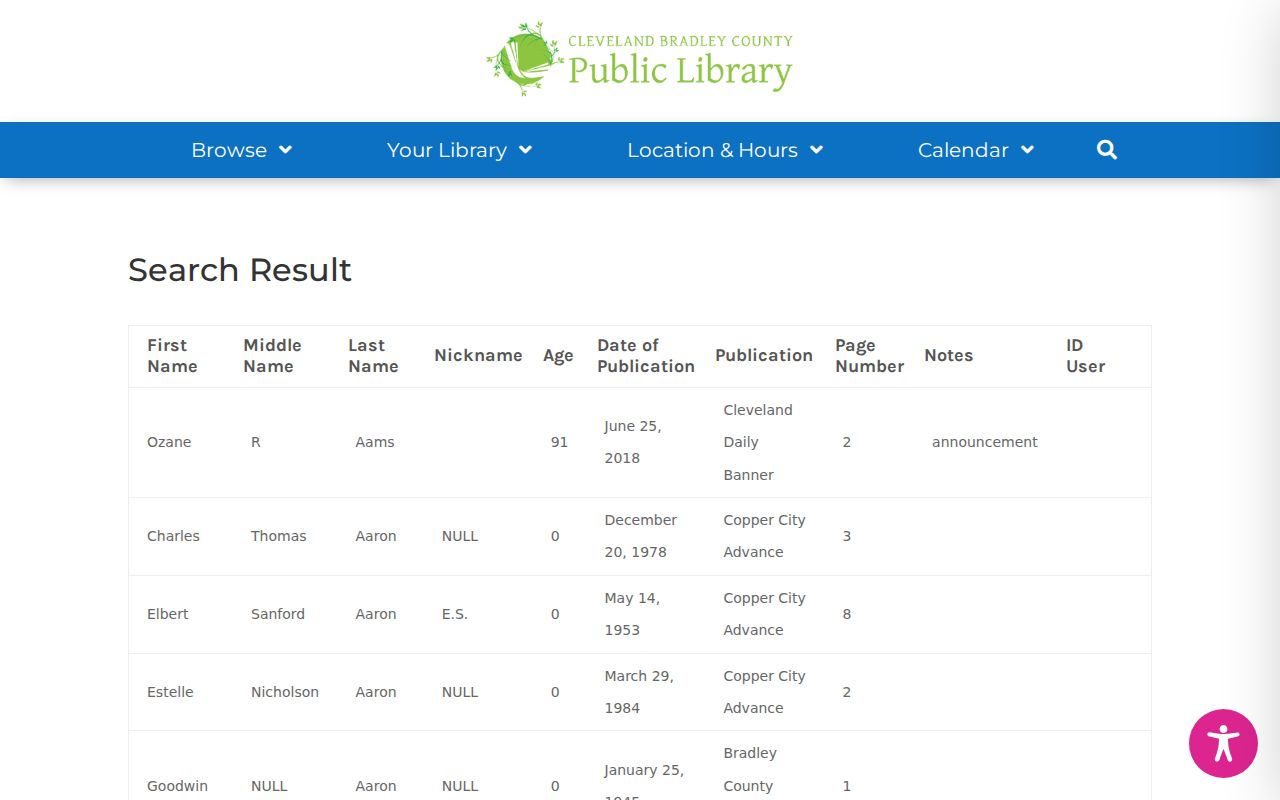
The index is free to search. The History Branch reports that an obituary copy requested by mail or email costs $2, subject to its request instructions. A page number is especially useful for locating the original newspaper reel.
Note: An obituary index is a newspaper finding aid, not a death certificate or a complete household listing.
Cleveland City Directory Newspapers
Newspaper microfilm gives Cleveland research a longer local run than the known directory leads. The branch lists papers from 1854 through 1970 on microfilm, including the Cleveland Daily Banner. Search the date of a move, marriage, death, court notice, business notice, or property event after checking the directory entry. The library also lists licensed databases such as Ancestry Library Edition, HeritageQuest, Gale, ProQuest Historical Newspapers Tennessean, and Tennessean access from 2002 onward, with account, IP, or in-library limits possible.
Use the newspaper date as its own fact. A printed notice can follow a move or death, while a directory may reflect an earlier collection period. The branch's local maps, family files, and early court material are useful fallback channels when a particular directory year is missing.
Cleveland City Directory Dates
The known sequence is uneven, so it should be treated as a set of verified leads instead of a seamless run. Cleveland was platted in 1838, and the city grew around the public square, Ocoee Street, rail service, and later industrial corridors. That history helps explain why an older source may refer to a courthouse-square location or a street spelling that needs comparison with plats, maps, and nearby lots.
| 1838 | Cleveland was platted; local history describes a log courthouse at the southwest public square. |
|---|---|
| 1839 | A brick courthouse followed, according to the historic residential manual. |
| 1854 | The Cleveland Daily Banner began, creating a later microfilm trail. |
| 1949 and 1952 | Directory leads cited in an official historic-nomination bibliography. |
| 1959-1966 and 1990-1992 | Further directory years listed in a state-library-related holdings lead. |
Neither a first Cleveland directory nor a final printed year was verified. The date of printing, the date of an event, and the date a deed was recorded are different dates and should remain separate in research notes.
Cleveland City Directory Maps
When a directory address does not line up with a modern parcel, map sources can steady the search. The NPS nomination identifies Cleveland Sanborn years of 1925, 1930, and 1950. Those sheets can show a building footprint, lot shape, street context, construction material, or historic use. They do not identify every person who lived there. Pair a map with a volume, census, deed, obituary, or permit record instead of treating it as a resident list.
The Bradley historical holdings lead also points to an 1850 courthouse-square map and 1860-1861 gazetteer or business-directory material.
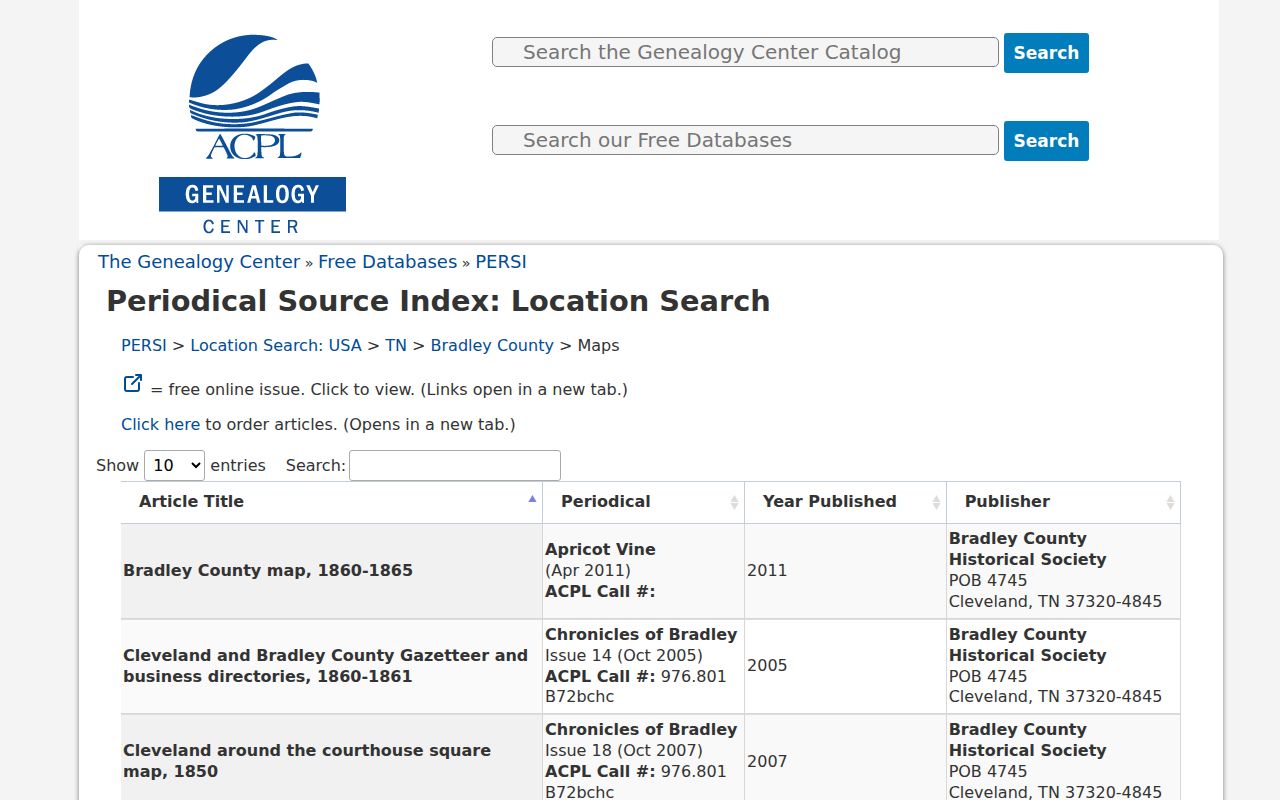
These are leads to verify with the holding institution. The accessible source did not establish a complete local collection or confirm a Cleveland-specific Sanborn scan in the Library of Congress Sanborn collection.
Note: No verified courthouse-fire loss explains a directory gap, so a missing volume should not be attributed to one without a record-group source.
Tracing Cleveland City Directories
Start with the closest known name and address, then work one volume at a time. A move, initials, a spouse notation, or a business reference may explain an apparent non-match. Pair each printed year with the nearest available federal census and then use land or obituary material to test the sequence. Census research is public through 1950 under the National Archives 72-year rule; later federal schedules remain restricted until their release date.
- Ask the History Branch for the first available volume near the known address or family date.
- Copy the name, page, address, every printed notation, and the volume's date without expanding abbreviations prematurely.
- Check alternate spellings, initials, the street section if the local volume has one, and any business listing.
- Repeat in the next available volume and make a dated list of address, relationship, and notation changes.
- Compare the closest census, then check deeds or an obituary notice when a person disappears or a property changes hands.
The National Archives census research page is the official route for census access and release context. For older Cleveland books or reels that are not online, the History Branch, the Tennessee State Library and Archives, and a holding institution's staff are the documented fallback chain.
Cleveland City Directory Gaps
A blank year can mean the local shelf is incomplete, a platform holds the volume elsewhere, the issue was not published, or the name was recorded differently. It does not by itself prove that a household left Cleveland. Preserve the full directional suffix, test formal names and initials, and compare the lot or street intersection when a modern number looks unfamiliar.
For a single address history, the deed chain supplies ownership while the historical volumes and census provide separate household clues. The Cleveland previous residents page focuses on taking that address trail backward without treating ownership as proof of occupancy.